Monday, May 9, 2011

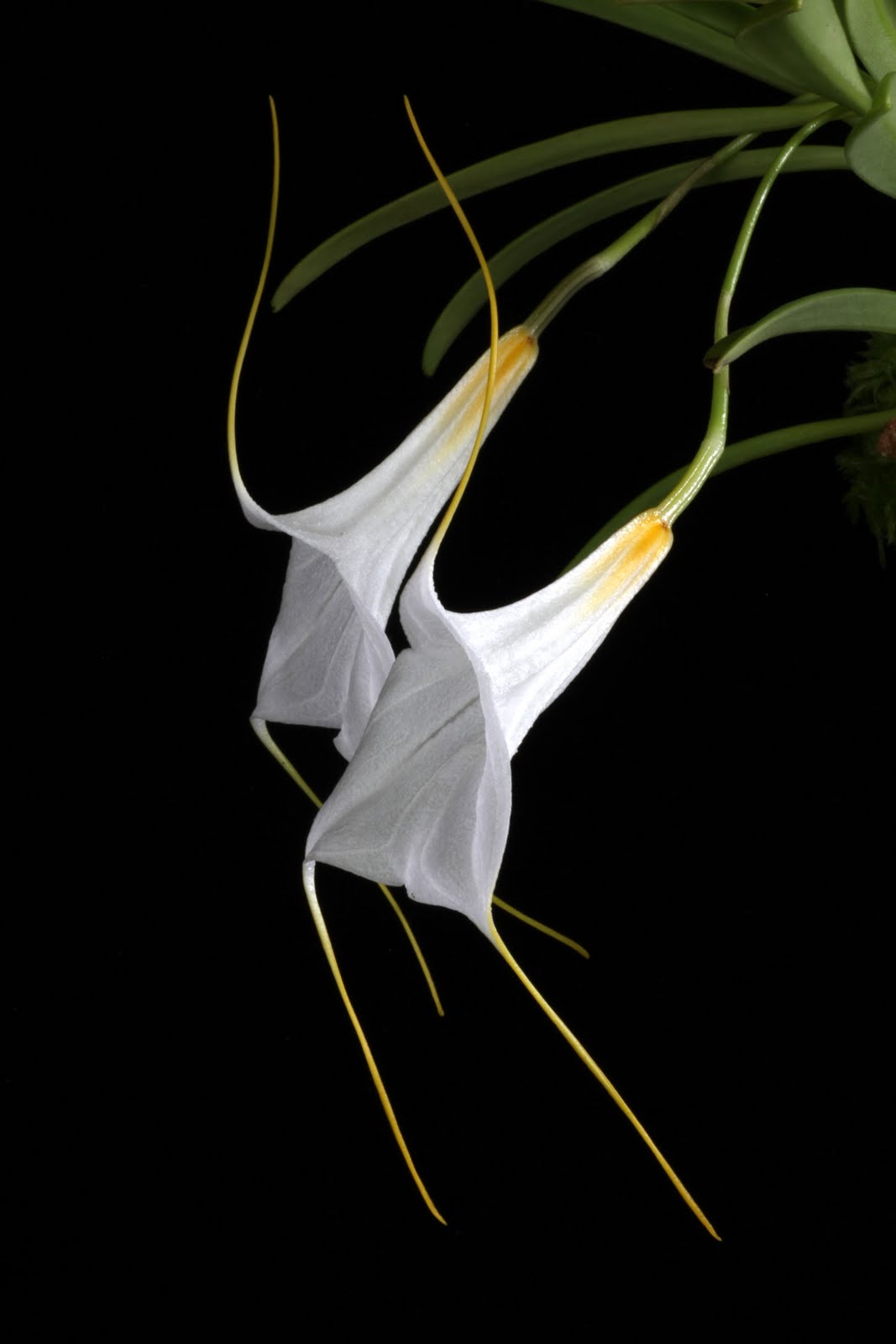
Masdevallia filaria

Masdevallia filaria is another species from the Saltatrices section of Masdevallia.  Compared with the flowers of Masdevallia ventricularia in the previous post the relationship is obvious.  Both have the tubular shape and "belly" that are characteristic of this section.

The plant of this species is about 10 cm tall and the flowers 5 cm in height.  Like the previous species it blooms in the spring and comes from Colombia.  Its name, filaria, refers to the thread-like tails of the flowers and it sometimes considered to be the same species as ventricularia.


Monday, May 2, 2011

Dracula lotax

This is one of those orchid names that makes me laugh.  There is a whole group of orchids, well over a hundred species, called Draculas, named for their odd flowers and their fancied resemblance to a dragon's mouth.  They are related to Masdevallia and belong to the group of Central and South American orchids known as Pleurothallids.

The name of this species is especially humorous since lotax means "clown," so that it is literally the "Clown Dracula," which is rather incongruous.  It is so named however, because it has a little clown's face in the center of the flower.  It is the name Dracula that really does not fit, since this miniature species does not have the dark, bat-wing flowers of some other species in the genus.

The plant is 12 cm tall and the flowers about half that size.  It requires relatively low light, cool and damp conditions, and can be grown in a pot since its flower spikes are held upright, unlike those species that send their spikes downward.  I grow it in live sphagnum moss in a net pot and keep it as far away from the lights as is possible in my orchidarium.


Friday, April 29, 2011

Dendrobium malvicolor

Dendrobium malvicolor is another delightful miniature orchid.  It is native to Sumatra and is reputed to be very tolerant of different growing conditions.  I grow it cool but it is supposed to tolerate warm temperatures as well.  It is best grown mounted and is supposed to have a dry rest in the winter.

The growths are about 5 cm long and are thin and wiry at the base, thickened towards the top rather like a club.  It flowers in late winter or spring after dropping its leaves and the flowers come in clusters of three to five.  They appear to be white but actually have a pinkish blush especially at the base of the flowers.

The tip of the column is also bright purple, adding interest to the flowers.  Its name, malvicolor, refers to the supposed resemblance between the color of its flowers and those of the mallow plant.  It belongs to the section Pedilonum and has long-lasting flowers, that have a sparkling, crystalline texture, eviden especially in the last photo.


Schoenorchis seidenfadenii

Schoenorchis seidenfadenii is tiny but charming orchid related to the huge Vandas.  It grows in a little fan of thick fleshy leaves and produces an abundance of tiny pinkish flowers in the spring.  The individual flowers are less than 1 cm in size but are born on densely flowered sprays.  It is native to Thailand and Vietnam and is best grown mounted.  It is supposed to be warm growing, but I have it with my cool growing plants where it does very well, growing and blooming reliably.


Masdevallia filaria

For some reason I am especially attracted to the flowers of the Saltatrices group of Masdevallias, perhaps because their flowers are so odd.  The flowers in this group are all tubular, many with a kind of bulging "belly": at the base of the flower.  The flowers often are bug-like or slug-like.


Masdevallia ventricularia is usually much more bright colored.  This is a very pale form, but its 7 cm flowers, large for the size of the plant, have the typical tubular shape and "belly" of the group.  It is from Colombia and Ecuador and is a small plant of about 10 cm.


Wednesday, April 6, 2011

Masdevallia welischii 'Rip Hoff'

Love that clonal name.  Whoever used it had a since of humor - maybe paid too much for the plant.  Hard to imagine that, though, since this is a spectacular Masdevallia species from Peru.  It has 15 cm narrow but thick channeled leaves that take a bit more light than some plants in the genus.  The flower spikes are 35 cm and stand well above the plant.  The flowers are 7 cm from tip to tip, somewhat small for the size of the plant, but remarkable for their color and glandular hairs.  Unlike other Masdevallias with these "hairs," however, these flower have them mainly on the dorsal sepal, which appears to be much darker than the rest of the flower as a result.  The striking orange and red flowers are also darker on the exterior than the interior.


Saturday, April 2, 2011

Masdevallia datura

One of my favorite Masdevallias, this species from Ecuador has huge flowers on a small plant.  The plant is about 12 cm tall, but the flowers are nearly the same size from the back of the flower to the tip of the tails, and even larger, 15 cm, from tip to tip.  The name, datura, refers to the flowers' resemblance to those of the Moonflower, Datura inoxia, which they do indeed resemble both in color and form.  The plant flowers primarily in the spring, and the flowers have a faint, lily-like fragrance.