Monday, October 21, 2013
Barbosella cogniauxiana
A Brazilian species, this orchid is really tiny, growing as a mat of oval leaves that are only 1.5cm, with flower spikes of 5cm and single 3cm flowers. The plant is temperature tolerant and easy to grow and can produce a mass of flowers that almost completely hide the plant itself. It is best grown mounted, and my plant, rather recently acquired is glowing on a piece of a branch. It is related to Pleurothallis and belongs to a small group of species from Central and South America.
Wednesday, October 16, 2013
Dracontia pachyglossa
Dracontia pachyglossa, also known as Pleurothallis paphyglossa, is a species from Mexico, Guatemala and Costa Rica. My plant is 15cm tall with flower spikes equally long that come from the base of the leaf and bloom successively with four to five 2 cm flowers. The plant is temperature tolerant and like most Pleurothallids prefers good humidity and air movement.
Friday, October 11, 2013
Stelis hirtella
These two tiny little Stelis are from Peru and Ecuador, at least if it is correctly identified. I received the first species (with the purple-centered flowers) as an unidentified Stelis from Ecuador. Someone has suggested that it is Stelis hirtella and and some of the pictures I've seen of that species match, though others do not. The second plant, which does not have the purple centers, is also identified as Stelis hirtella, and is similar in plant size and form. The plants are 3cm tall with 5-6cm flower spikes and 6mm flowers. Perhaps someone who sees this posts is expert enough to sort these two out, but the Stelis species are notoriously difficult to distinguish.
Plant #1
Plant #2
Labels:
ecuador,
orchid,
peru,
pleurothallid,
stelis,
stelis hirtella
Friday, October 4, 2013
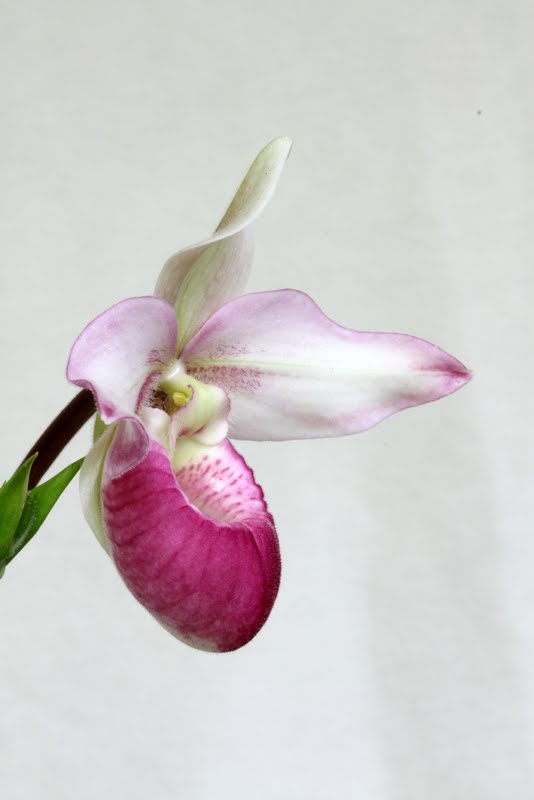
Phragmipedium Cardinale 'Birchwood' AM/AOS
Phragmipedium Cardinale 'Birchwood' is an awarded clone of an older Phragmipedium hybrid. It is a hybrid of Phragmipedium schlimii and Phragmipedium Sedenii. The plant actually belongs to my son who won it at the last orchid society Christmas dinner. It was in bloom at that time, but not doing very well, with a lot of dead leaves and black leaf tips. We keep it in a saucer of water so that it is soaking wet at all times and grow it on a bathroom windowsill. It has put up numerous new growths and the black leaf tips have stopped. It has just started blooming and this is its first flower.
Tuesday, October 1, 2013
Dendrobium cuthbertsonii (three new plants)
I've posted many pictures of Dendrobiuum cuthbertsonii in the past. These are photos of three new acquisitions, one a nice clear orange and the other two bicolors (somewhat hard to see on the third photo). Dendrobium cuthbertsonii is a micro-miniature species from New Guinea with huge (for the size of the plant) and long-lasting flowers (six months or more). The species is considered to be difficult, but with the right conditions is relatively easy to grow and flower. It prefers cool temperatures, high light and constant moisture to do well.
Monday, September 23, 2013
Dendrobium agathodaemonis (red)
Dendrobium agathodaemonis is very closely related to Dendrobium cuthbertsonii and considered to be the same species by some. To my mind, however, they are quite different, the former species having very thin growths and flowers without the dark lip markings that Dendrobium cuthbertsonii has. This is a plant I grew from a seedling and which has rather small but very clear red flowers. The plant is only a couple of centimeters tall and the flowers around three centimeters long. Like its close relative, it is from New Guinea and is cool growing.
Friday, September 20, 2013
Epigeneium nakaharaei
Epigeneium nakaharaei is from Taiwan and is closely related to Dendrobium. In fact, it was once classified as a Dendrobium. The growths are 3-4 cm and the flowers 2.5 cm with a glossy brown lip. It quickly forms a large clump and scrambles all over and for that reason is best grown on a mount. It blooms in the autumn.
Subscribe to:
Posts (Atom)