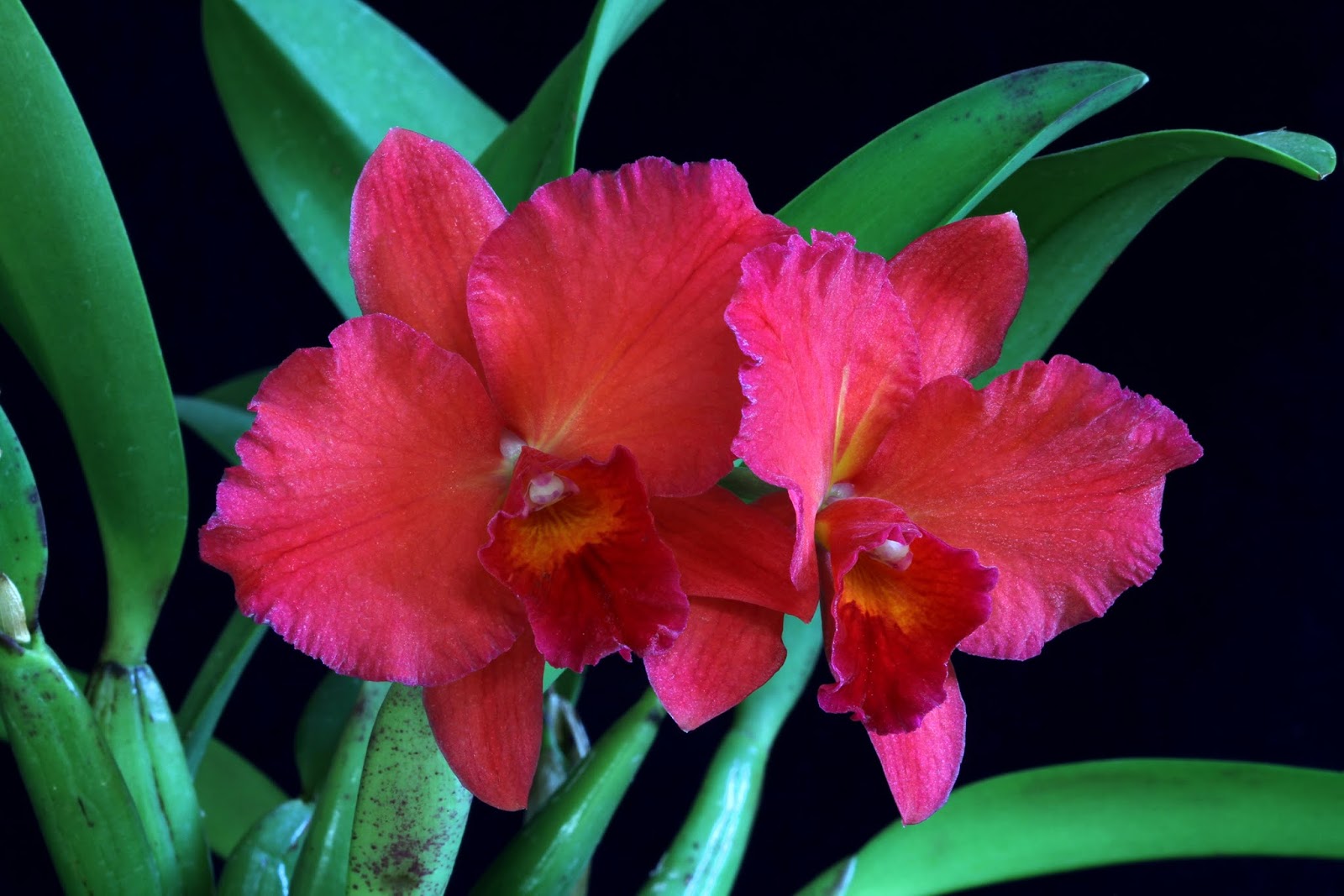
This is one of the few hybrids I grow and one of the few Cattleyas I grow. It's a hybrid of Laeliocattleya Culminant and the tiny red species, Sophronitis coccinea and due to the renaming of the species in its background would now be known simply as Cattleya Circle of Life. It is a small plant as Cattleyas go, only 25 cm tall with 7-8 cm flowers, two per growth. It blooms faithfully every winter or spring and is one I raised from a very small seedling.
Showing posts with label sophronitis coccinea. Show all posts
Friday, December 2, 2016
Sophrolaeliocattleya Circle of Life
This is one of the few hybrids I grow and one of the few Cattleyas I grow. It's a hybrid of Laeliocattleya Culminant and the tiny red species, Sophronitis coccinea and due to the renaming of the species in its background would now be known simply as Cattleya Circle of Life. It is a small plant as Cattleyas go, only 25 cm tall with 7-8 cm flowers, two per growth. It blooms faithfully every winter or spring and is one I raised from a very small seedling.
Tuesday, January 20, 2015
Sophrolaeliocattleya Circle of Life
This is one of the few hybrids I grow and one of the few Cattleyas I grow. It's a hybrid of Laeliocattleya Culminant and the tiny red species, Sophronitis coccinea and due to the renaming of the species in its background would now be known simply as Cattleya Circle of Life. It is a small plant as Cattleyas go, only 25 cm tall with 7-8 cm flowers, two per growth. It blooms faithfully every spring and is one I raised from a very small seedling.
Monday, February 10, 2014
Sophrolaeliocattleya Circle of Life
I grow mostly miniature species, but have a few Paphiopedilums, Phalaenopsis and Cattleyas that I grow on windowsills and this is one of them, a hybrid of Laeliocattleya Culminant and the tiny red species, Sophronitis coccinea. It blooms faithfully every spring and is one I raised from a very small seedling.
Tuesday, February 26, 2013
Sophronitis coccinea 'Fourth Dimension'
My 4N Sophronitis coccinea is in bloom once again, this year with two flowers. I find it a rather slow grower, though it has good form and blooms reliably every spring. The flowers are 7 cm across when fully developed, but when they first open are only 3 cm and get larger over quite a long period of time. This species is known for its brilliant color and small size and has been much used in hybridizing for those reasons. This particular clone is a tetraploid and has extra fine size, shape and substance for that reason. I grow it in a clay pot in sphagnum.
Thursday, December 6, 2012
Sophrolaeliocattleya Circle of Life
I do not grow a lot of Cattleya hybrids, in fact, I do not grow a lot of hybrids of any kind, but several years ago in a fit of madness, I brought a whole raft of seedlings from one of the best hybridizers around and many of them have now bloomed, though as they bloom I sell them off. Don't know if I'll sell this one, though.
Sophrolaeliocattleya or Slc. (Cattleya if you prefer the new names) Circle of Life is a hybrid of Laeliocattleya (Lc.) Culminant and Sophronitis coccinea, a miniature fiery red species. The plant is 13-15 cm tall and the flowers are 10 cm across. This is its first bloom with four flowers on two spikes.
Saturday, August 20, 2011
Sophronitis coccinea 'Fourth Dimension'
About a year ago I received a division of a selected clone of Sophronitis coccinea from my good friend, Duane McDowell, who also gave it its clonal name. It has finally bloomed on a summer growth, not its usual bloom time but welcome nevertheless. It is a plant that seems to need to be established before blooming, but I have been waiting very impatiently for its first bloom.
The plant is typical for this species, 9-10 cm tall with leaves that are almost solid dark purple when grown under high light. The flower is a bit smaller than other plants I've grown, 6 cm across, but is beautifully formed with very large petals, by far the best clone I've ever had. I should add though, that the flowers continue to increase in size for quite some time after they open and perhaps this still has a ways to go.
Soph. coccinea is probably the most beautiful of all the cool-growing miniature orchids and has been extensively used in hybridizing Cattleyas to produce both miniature plants and sunset colors. It has been much bred by the Japanese who have produced clones that are less temperamental and more warmth tolerant, but it remains some difficult to grow well unless its requirement are met exactly.
Mine never dries out and the temperatures never go above 80 degrees (27 Celsius), and are usually around 70 dropping into the 60's at night. I grow it in live sphagnum in a clay pot (which, I believe, helps keep the plant cool through evaporation). It produces mostly blind leads through the summer and never seems to bloom on every growth, but is a beauty nonetheless.
The species is native to Brazil but is increasingly rare in the wild due to over-collecting, most of it illegal. It is one miniature orchid I would not be without and which I've grown now for many years, with varying success. It is available from a number of dealers, often as seedlings from carefully selected crosses and can be quite expensive to purchase, especially in its rarer forms.
The plant is typical for this species, 9-10 cm tall with leaves that are almost solid dark purple when grown under high light. The flower is a bit smaller than other plants I've grown, 6 cm across, but is beautifully formed with very large petals, by far the best clone I've ever had. I should add though, that the flowers continue to increase in size for quite some time after they open and perhaps this still has a ways to go.
Soph. coccinea is probably the most beautiful of all the cool-growing miniature orchids and has been extensively used in hybridizing Cattleyas to produce both miniature plants and sunset colors. It has been much bred by the Japanese who have produced clones that are less temperamental and more warmth tolerant, but it remains some difficult to grow well unless its requirement are met exactly.
Mine never dries out and the temperatures never go above 80 degrees (27 Celsius), and are usually around 70 dropping into the 60's at night. I grow it in live sphagnum in a clay pot (which, I believe, helps keep the plant cool through evaporation). It produces mostly blind leads through the summer and never seems to bloom on every growth, but is a beauty nonetheless.
The species is native to Brazil but is increasingly rare in the wild due to over-collecting, most of it illegal. It is one miniature orchid I would not be without and which I've grown now for many years, with varying success. It is available from a number of dealers, often as seedlings from carefully selected crosses and can be quite expensive to purchase, especially in its rarer forms.
Subscribe to:
Posts (Atom)